The world seems like it’s going to end pretty soon, doesn’t it?
Sorry, I know that’s a pessimistic start to my blog post. Maybe the end of the world is a bit of an exaggeration, but it does seem like everything around us is going downhill. I’m going to narrow our scope down to just natural disasters, but there is still plenty that’s happening. Flooding in Mississippi and Pakistan, heat waves in Europe, wildfires in Oregon and California, and Hurricanes Fiona and Ian.
Almost every time I see a headline about another tragic natural disaster in the news, it’s always “unprecedented”. But really, these disasters are completely precedented. Climate change is literally changing the way our world works, and this means changing the way natural disasters work. They’re coming in increasing frequency and intensity, and this is a trend that will continue for the foreseeable future.
This probably won’t come as a surprise, but the house you’re living in isn’t exactly helping the situation. In my last post, I told you to look around. Let’s revisit that, except instead of going outside and staring at a building, I want you to find the closest vent. Yup, the vent. Put your hand over it. Is any air coming out? Is it hot or cold? Chances are, you answered “yes” and “hot” to both those questions.
Congrats! You’re causing climate change. Don’t be worried though. I mean, we should all be very worried, but the amount of carbon dioxide that Exxon Mobil releases is enough to compete with quite a few of your lifetimes, so you’re really not at fault. But combine that with all the air conditioned homes in the world, and we have a problem. Most homes and apartments in America have traditional heating and cooling systems that run off of fossil fuels. No matter how you kept cool this summer – excluding watching the new Stranger Things season in your birthday suit – it probably wasn’t sustainable. Very few homes are. Fortunately, there’s a solution for this – science.
The other day, I found an old book at home about sustainable architecture (perks of having a parent in your prospective career field that hasn’t given away a book since 2013), and when I opened a random page, I was met with a pretty bizarre picture.
It looked something like this, and I think the best way to describe it would be if an alien spaceship had a baby with Antonio Gaudi’s architecture (I’ll do a whole blog post on him later). It’s all organic lines, neutral colors, and natural materials. Come to think of it, if this style had a motto, it would be “Organic and all-natural! It’s not Whole Foods, it’s Earthship Biotecture!” When I first saw the word “Earthship”, I was expecting a sleek, metallic, multi-million dollar home. Instead, I got something 100% different – and 1000% better.
Earthship biotecture is an architectural style pioneered by American architect Michael Reynolds in the early 21st century. It’s the ultimate sustainable home, using natural materials and passive methods to stay a cool 70 degrees year-round in the extreme, arid Taos climate.
The Earthship style has six design tenets that all its homes live by: Repurposed materials, solar heating and cooling, solar electricity, water harvesting, sewage treatment, and food production.
All the homes are made from recycled and natural materials – most notably used tires packed with dirt. As you can see in the picture below, glass bottles in the walls offer a stunning, kaleidoscope effect, with the added benefit of passively cooling the home. The homes are also encapsulated by earth, again cooling the home and preserving the natural landscape.
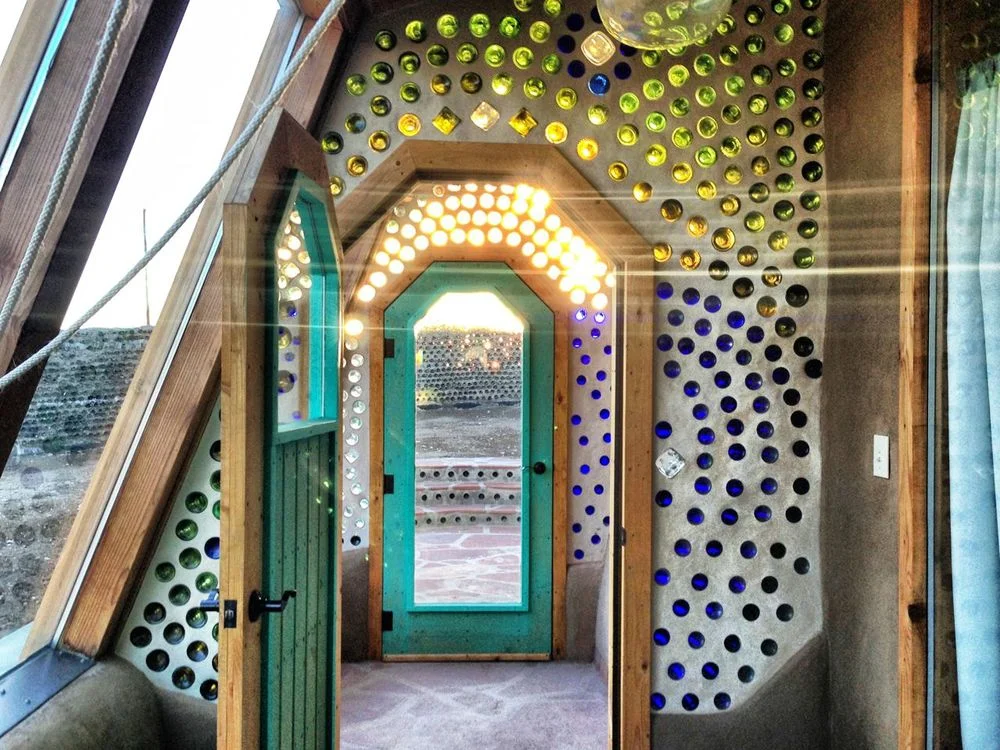
The aspect of the Earthship style that intrigued me the most at first was net zero heating, cooling, and electricity. Be forewarned, I had to take a few minutes to process this because it is the single coolest thing I’ve read all month (sorry, William Faulkner). But first, I’d check out this video to see the building process.
When I talked about the tires, I forgot to mention that they’re 300 pounds each. This might seem excessive, but don’t forget that the only thing holding up the structure are these walls, with no concrete foundation (fun fact: 8% of global CO2 emissions come from concrete!). The blueprint for an Earthship home has three sides of tire walls and one south-facing window wall, and the idea is that the sunlight coming through the window will heat the floors, and as the day approaches evening, heat initially trapped in the tire walls will leak into the home, heating it for the night. Now think about your vents. Pretty stupid, right?

But it’s 2022, and I know I can’t live without electricity. In an Earthship home, you don’t have to! With ultra-efficient appliances installed throughout the home, solar panels are enough to cover all electrical needs, which is still only 25% of conventional homes.
Being in New Mexico, water collection is a major issue. All water used in an Earthship home comes from rainwater runoff or snowmelt. Beyond that, used water goes through four steps before the end of its cycle: interior plants use and treat the water until it’s clean enough to be used for flushing. After it travels to a septic tank, the water is finally used by exterior plants. The interior plants are actually fresh produce that residents live off of.
I know this is already an excessively long blog post, but I could honestly write about Earthship architecture for hours. It actually functions as a sort of neighborhood, where resources are shared – yet it’s still so sustainable! It’s a very different lifestyle than our Napervillian utopia, but all it takes is some getting used to. So to anyone reading this: if I go off the grid in 15 years, you know where I’ll be. In fact, you should come join me – me and my glass bottle walls would love to have you.
Works Cited:
EarthshipGlobal. “Earthship Biotecture Michael Reynolds.” Earthship Biotecture Michael Reynolds, 2022, www.earthshipglobal.com/. Accessed 14 Oct. 2022.
Earthship Biotecture. “Earthship Global Model: Radically Sustainable Buildings.” YouTube, 29 Nov. 2011, www.youtube.com/watch?v=N2so9hyNWxc. Accessed 14 Oct. 2022.
Ramsden, Keegan. “PSCI.” PSCI, 3 Nov. 2020, psci.princeton.edu/tips/2020/11/3/cement-and-concrete-the-environmental-impact. Accessed 14 Oct. 2022.
Anjana!! This is so cool! It’s always fun to read about things my friends are passionate about, and I’m super SUPER impressed at your depth of knowledge. It’s amazing that the earthship designs can be so beautiful and also so beneficial for the environment. The way you describe architecture, as a blend of aesthetic creativity and concrete benefits (no pun intended) makes it sound like something you’d really thrive in. Look forward to reading your next post, Miss architect!
Hi Anjana! I am your mandatory commentator of the week (haha). I love the topic of your blog for this week. I think climate change is a super important topic in today’s news, and we (as a whole of humanity, not just you and me) need to start caring more about our planet before we ruin it. I like the way you show how we contribute to global warming and climate change, but don’t place all of the blame on us. That is something that drives me crazy – when people blame all of climate change on consumers, rather than acknowledging the companies and corporations that truly cause climate change. I also love how you used photos in your piece. The images of the state of the art ‘Earthship’ are so cool when you talk about how you found your old book and included those photos from it. I love the architecture, with the organic-ness of the Earthship and the stained glass surrounding the front door. All in all, I love how you approach and talk about climate change, and how you tie in the sustainability of the Earthship as a new and futuristic way to approach climate change. I can’t wait to hear more from you on your blog, and I am so excited about your upcoming post about Antonio Gaudi. Thank you so much Anjana!
Anjana — It was really cool to open up your blog and be met with so much comprehensive information about architecture! Scholastic bowl has cemented in my brain that Frank Lloyd Wright designed Fallingwater and I.M. Pei did The Louvre, but that’s pretty much the extent of my knowledge on the subject, so I appreciated getting to learn more.
I wasn’t very familiar at all with the idea of sustainable architecture before this, so it was really interesting to read about Earthship biotecture. The idea of walls made of massive tires that contain heat for the night was especially cool to think about, and the process of water collection and reuse seems really relevant today. You’ve definitely piqued my interest regarding more sustainable alternative approaches to elements of our typical lifestyles, and I’ll be thinking more now about how intentional and well-designed architecture can be. That video you linked of the Earthship style building process was also strangely hypnotic.
Anyway, your passion for the topic of architecture and extensive knowledge on the subject makes for a really enjoyable reading experience!
Hey Anjana,
I loved your blog post! I clicked on it because of the extremely intriguing title and it did not disappoint. I had never heard of Earthship architecture and I really think that if it could be implemented properly, this innovation could greatly impact climate change as you mentioned. I also think it would be a great idea to start incorporating some of the characteristics that these houses have into homes today. For instance, the kaleidoscope bottle effect does not only have to be in an Earthship architecture style home, people could try to DIY it at home on a smaller scale. Another idea that could be implemented in the normal home is the idea of ultra-efficient appliance and solar panels. My point is, these homes can serve as inspiration for current home-owners to make small strides to make their own homes more eco-friendly without having to buy a new house.
Other than the content, I love your writing style throughout the post. Your witty comments and lighthearted jokes made this post all the more enjoyable to read. I look forward to more!